
What's Really Behind People-Pleasing?
If you’re someone who says yes when you mean no, who apologises for things that aren’t your fault, or who feels a low hum of guilt every time you put your own needs first, you’ve probably been called a people-pleaser at some point. Maybe you’ve even worn it as a badge, a way of being “the easy one” or “the helpful one.” But underneath that habit is usually something much older and much heavier than a personality trait. Transactional Analysis (TA) gives us a vivid way to understand what’s really going on, through what’s known as the Drowning Person diagram.
The Diagram: Weights and Balloons
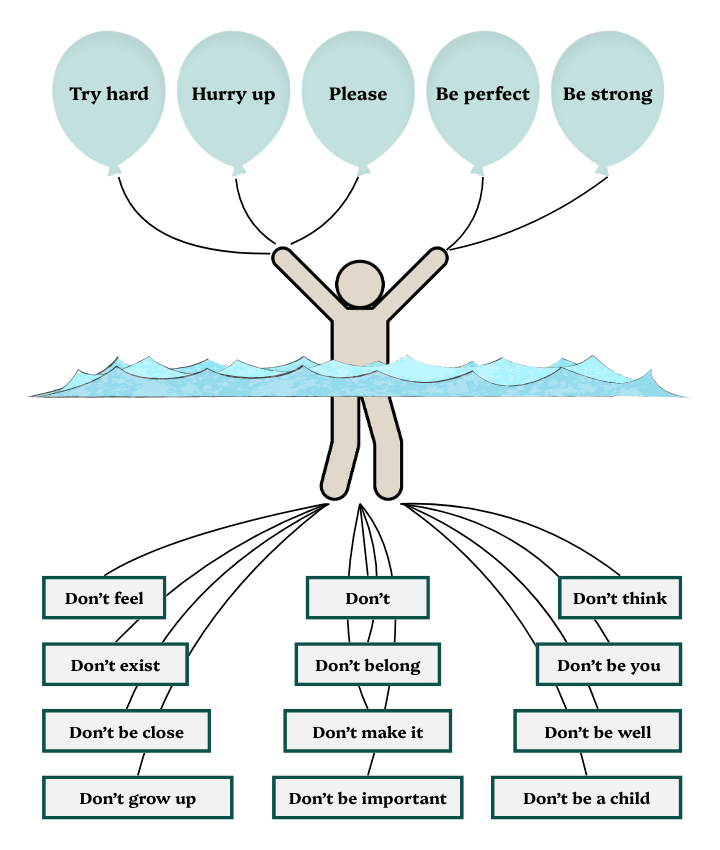
Picture someone in deep water. Tied around their ankles are lead weights, pulling them steadily downward. To stay afloat, they grab hold of a set of helium balloons, and it’s these balloons that keep their head above water, at least for now. This is the image TA practitioners use to explain the relationship between two key ideas: injunctions and drivers.
The weights represent injunctions. These are early, often unconscious messages a child absorbs about themselves, usually before they even have language for them. Messages like “Don’t be important,” “Don’t belong,” “Don’t be close,” “Don’t feel,” or “Don’t be you.” Nobody hands a child these messages directly. They’re picked up from tone, from what got rewarded or punished, from the atmosphere of a household, sometimes from a single moment repeated enough times to sink in.
The balloons represent drivers, sometimes called counter-injunctions. These are the strategies a person develops to survive the pull of those weights. The five recognised drivers are Please Others, Try Hard, Hurry Up, Be Perfect, and Be Strong. They’re not flaws. They’re solutions a child came up with, remarkably resourceful ones, to stay afloat in a situation that felt unsafe or unstable.
Where People-Pleasing Fits
If you recognise yourself as a people-pleaser, you’re almost certainly holding onto the Please Others balloon. It shows up as a constant scanning of the room. What does this person need? Are they upset? Did I do something wrong? Is everyone okay? It’s exhausting, but it works, at least in the short term. It keeps you afloat.
Here’s the part that often gets missed though. The balloon isn’t the problem. The balloon is the thing that’s kept you alive. The real issue is what’s tied to your ankles underneath the surface, the injunctions that made “please others” feel necessary in the first place.
For many people-pleasers, the weights look something like this:
Don’t be important. If your needs, opinions, or presence felt like too much as a child, pleasing others becomes a way to stay small and safe, never taking up too much space.
Don’t belong. If you didn’t feel securely accepted in your family or peer group, constant appeasement becomes the price of admission, a way to earn a place at the table.
Don’t be close. Paradoxically, people-pleasing can also be a way to keep real intimacy at arm’s length. You manage people rather than truly connect with them, because closeness once felt risky.
Don’t feel. If your emotions were dismissed or overwhelming to the adults around you, focusing entirely on other people’s feelings becomes a convenient way to avoid your own.
Don’t be you. If your authentic self wasn’t welcomed, pleasing others can become a full-time substitute identity, one built entirely around anticipating what others want rather than knowing what you want.
None of these were chosen consciously. They were survival decisions made by a much younger version of you, working with whatever information was available at the time.
Why the Balloon Isn't Enough
The trouble with balloons is that they only keep your head above water. They don’t get you out of the pool. You can spend decades gripping the Please Others balloon, becoming exceptionally good at reading rooms and managing other people’s emotions, and still feel like you’re drowning underneath it all. That’s because the weights are still there. The balloon manages the crisis; it doesn’t resolve it.
This is often why people-pleasers describe feeling resentful, depleted, or strangely invisible even while surrounded by people who seem to like them. The strategy is working exactly as designed, but it was never designed to make you feel fulfilled. It was designed to keep you safe.
Loosening the Weights, Not Just Letting Go of the Balloon
A common mistake, both in self-help advice and in some approaches to changing behaviour, is to tell a people-pleaser to simply stop pleasing people. Just say no more often. Set better boundaries. While well-intentioned, this misses what’s actually happening underneath. Asking someone to drop the balloon before dealing with the weights is asking them to sink faster.
A more compassionate, and more effective, approach starts with the weights. In therapy, this often looks like gently exploring where the injunction came from. When did you first learn that you weren’t important, or that closeness wasn’t safe, or that your feelings were too much? What happened, and who was around when it happened? This isn’t about blaming parents or caregivers; most people pass on injunctions without ever intending to, often repeating patterns they absorbed themselves.
As the injunction loses some of its grip, often through being named, understood, and gently challenged in a therapeutic relationship, the need for the balloon naturally starts to ease too. You don’t have to force yourself to stop people-pleasing. You start to notice you don’t need it quite so tightly, because the thing it was protecting you from feels less threatening than it used to.
A Question Worth Sitting With
If people-pleasing is a pattern you recognise in yourself, it might be worth asking, gently and without judgment: what would happen if I stopped pleasing this person, right now, in this moment? Not what would you do differently, but what feeling comes up. Fear of rejection? A sense of not mattering? Discomfort with being truly seen? Whatever surfaces is likely pointing toward the weight underneath the balloon, and that’s usually where the real work, and the real relief, begins.